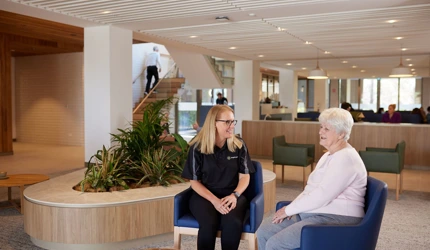
If you’re currently receiving help through the Commonwealth Home Support Program (CHSP), you may have heard about the Australian Government’s new Support at Home program and wondered whether it’s right for you. With dedicated care partners, a wider range of services and tailored levels of support, Support at Home is designed to help older Australians stay safely and confidently at home for longer.
To help you decide if the time is right for you, we spoke with Brightwater at Home Service Lead Fern Raynham about how the two programs compare and when it might be the right time to consider a change.
A quick look at the Support at Home program
Support at Home is the Australian Government’s home care program for older people who need a little more help to live independently and keep doing the things they love. It brings together previous home care packages into a single program with eight levels of care, ranging from light support through to high-needs clinical care.
“Support at Home is a more complex clinical program than CHSP. It’s coordinated, so you have a designated care partner who acts as that conduit between all the different services you may need to remain at home,” Fern said.
In short, it’s designed for people whose care needs are growing and who would benefit from someone helping bring it all together.

How does Support at Home compare to CHSP?
Both programs are government-funded and designed to help you stay at home. The key differences come down to coordination, the breadth of services available and how care is matched to your needs.
| Feature | CHSP | Support at Home |
| Best for | Older Australians who are largely independent | People whose needs are growing or changing |
| Care levels | One broad entry-level program | Eight levels matched to your needs |
| Service providers | Can use multiple providers for different services |
One provider for all your services |
| Care coordination | Self-coordinated | Designated care partner |
| Range of services | Domestic help, transport, social support, meals, light nursing, home maintenance | All CHSP services plus clinical care, allied health, and access to assistive technology and home modifications funding |
| Government-funded | Yes | Yes |
“With CHSP, you can have different services with different providers. That means you can get meals from one, transport from another,” Fern said. “Support at Home is a single-provider service, so everything sits in one place.”
Read more: Support at Home Pricing Explained: What you need to know
The biggest benefit: a care partner in your corner
Ask Fern what makes Support at Home truly stand out, and the answer is immediate.
“Having a dedicated care partner is a huge benefit to Support at Home,” Fern said.
A care partner is a designated point of contact who knows you, your goals and your story. They:
- Coordinate your services so you don’t have to
- Check in after events like a fall or hospital stay
- Refer you to allied health professionals such as Occupational Therapists, Physiotherapists, Dietitians and Speech Pathologists
- Help you apply for additional funding when you need it
- Liaise with My Aged Care on your behalf
- Keep you up to date on new services and community groups in your area
- Review your care plan as your needs change.
“Your care partner might tell you about a new meal service available, or a new community group down the road for social support,” Fern said.
“There’s a lot more ability to react quickly on Support at Home. For example, your care partner might be concerned about your weight loss and refer you to a dietitian.”
For families, having a trusted aged care professional looking out for their loved one is often the deciding factor.
“Some clients change to Support at Home because of the care manager. The family doesn’t have to worry so much and navigating the system is easier. You’ve got a central point of contact. You’ve got quality advice,” Fern said.
Read more: The New Support at Home Program – Your Questions Answered
What stays the same when you switch from CHSP to Support at Home
The good news is that moving to Support at Home doesn’t mean starting over.
“If clients move across with Brightwater, they have the benefit of keeping the same OT, the same nurse, the same physio and the same care workers,” Fern said.
The day-to-day services you rely on don’t change either. Whether you’re on CHSP or Support at Home, you’ll still get your floors washed, your kitchen cleaned, and the dusting taken care of. Social outings stay the same too. If your support worker takes you to the local men’s group every Thursday for fish and chips, that doesn’t have to change.
“You’re getting the same quality of services regardless of which program you use,” Fern said.
How a Support at Home Care Partner makes a difference: two examples
After a fall: Geraldine, 82, has a fall at home and spends a few days in hospital. Her care partner contacts her, organises an occupational therapist and physiotherapist to assess her home, and applies for assistive technology and home modifications funding to install grab rails and a shower stool. The equipment is delivered, fitted and reviewed without Margaret or her family worrying about anything or scheduling a single appointment.
Changing needs: Frank, 78, has been on CHSP for two years, getting help with shopping and cleaning. He’s recently become a little unsteady on his feet. His daughter lives interstate so she’s not able to keep on top of his day-to-day needs. Moving to Support at Home means his care partner arranges a physiotherapy assessment, suggests a local social group and connects him with a podiatrist. The care partner notices small concerns before they become big ones or before Frank mentions a need for help. The care partner proactively takes action to ensure Frank has the appropriate level of help to stay safe and independent in his home.
When is the right time to move from CHSP to Support at Home?
There’s no single right answer, but Fern offers a clear guide.
“If you don’t have a lot of family support and you’re struggling to coordinate your own needs, that’s a good time to look at Support at Home. That’s how you get your care partner,” Fern said.
Fern recommends being proactive about making the change.
“My best advice is: if you’re not sure, get yourself registered with My Aged Care for Support at Home and onto the waiting list,” Fern said.
“You don’t want to wait until you’re stuck in hospital with no other options. You want to plan ahead.”
Signs it might be time to start the Support at Home conversation:
- Your needs are increasing or your health is changing
- You’re finding it harder to coordinate multiple services and/or multiple vendors
- You don’t have family or friends nearby to help navigate the aged care system
- You’d like access to clinical and allied health services
- A family member is feeling stretched managing your care.
How Brightwater can support your move to Support at Home
If you decide to make the switch to Support at Home, Brightwater is here to make the process as smooth as possible. We’ll walk you through every step, from registering with My Aged Care to designing a care plan that fits your life. You’ll keep the familiar faces from Brightwater you’ve come to trust along the way.
If you’re not sure whether Support at Home is right for you, the first step is simply a conversation.